Book Reviews, Find Your Next Read

Her Kind by Sophie Lefens: A meditation on motherhood, friendship, and the refuge women create together

Sophie Lefens’s Her Kind is a beautiful, meditative novel about motherhood, friendship, grief, and the strange ways we prepare ourselves for loss. It is set on an almost dreamlike lakeside farm where a group of women create a temporary refuge from the rest of the world. This quietly immersive debut feels less like a story to race through than one to settle into, allowing its atmosphere and its questions about love and mortality to seep gradually into the reader’s thoughts. As someone who is frequently impatient with slow-moving novels, I found the writing here perfectly suited to the pace. The story moves slowly, but it never felt like it was dragging. Instead, the meditative quality of Lefens’s prose made me want to linger in this beautiful, strange world she created.

When Ada is left alone to raise her young son, Lenny, she retreats with him to her Aunt Leigh’s crumbling lakeside home. It is an extraordinary place to raise a child: surrounded by water, wildflowers, animals, and the rhythms of the natural world, with none of the constant negativity of Lenny’s father intruding on their lives. Ada has also managed to find part-time work that she enjoys and that allows her to spend a great deal of time with her son. There is an undeniable element of privilege in the life she has been able to build, particularly because so much of it depends on having an aunt like Leigh who can simply say, in effect, come live with me when everything falls apart. Not everyone has that kind of safety net.

Continue reading “Her Kind by Sophie Lefens: A meditation on motherhood, friendship, and the refuge women create together” →
On Storytelling

Why horror is the perfect genre for feminist rage #Spooktober

Horror has always been good at making the invisible visible. It takes the things we are afraid to talk about, the things we have learned to tolerate, and the things society has decided are simply part of life, and gives them teeth. That makes horror an especially powerful vehicle for feminism because so many of the experiences women navigate every day are frightening precisely because they have been normalized. Horror can take those experiences and ask a deceptively simple question: What if we made the consequences impossible to ignore?

A square comic-style graphic featuring a central woman with dark hair, expressing intense rage while holding a burning torch. The dark, cinematic illustration uses a charcoal and blood-red palette, featuring text that reads "WHY HORROR IS THE PERFECT GENRE FOR FEMINIST RAGE." Four surrounding panels depict different horror tropes: a woman trapped in pearls and cleaning supplies ("Domestic Traps"), a pregnant woman enveloped in thorns ("Loss of Autonomy"), a silhouette in a shattered mirror ("Impossible Standards"), and a shadow stalking a woman at night ("The Gaze").
Horror has always been good at making the invisible visible—taking the fears women carry quietly and turning them into something impossible to ignore.

Consider the fear of violence. Women are often taught from a young age to think about where we park, whether we should walk alone at night, what we wear, how much we drink, who we trust, and how we can avoid making ourselves vulnerable. These precautions can become so routine that we barely notice how extraordinary they are. We can internalize the idea that constantly assessing our surroundings is simply part of being a woman. Horror does not have to explain that fear, however. It can turn it into something physical: a monster waiting outside the door, a figure following the protagonist home, or an unseen presence that makes an ordinary environment suddenly dangerous. The genre can take a fear that women are expected to carry quietly and make the reader experience it as an immediate threat.

Continue reading “Why horror is the perfect genre for feminist rage #Spooktober” →
Book Reviews, Find Your Next Read

This B Just Won’t Die! by Tanya Pell: A feminist slasher about beauty, survival, and the final girl

Tanya Pell’s This B Just Won’t Die! is a gleefully bloody slasher that uses the conventions of the horror genre to take a much deeper look at the ways women are taught to understand their value through beauty, desirability, and the approval of others.

At first glance, This B Just Won’t Die! has all the ingredients of a fun horror romp. There’s an aging scream queen, a serial killer dressed as the villain from her old movies, a horror convention, a documentary crew, increasingly gruesome deaths, and a Final Girl who seems to have been dropped right back into the role that made her famous. But what makes the novel work so well is that Pell never forces the fun and the feminist commentary to compete with each other. The slasher is genuinely entertaining, while the ideas underneath it are substantial enough to give the story considerably more to chew on than its premise might initially suggest.

Continue reading “This B Just Won’t Die! by Tanya Pell: A feminist slasher about beauty, survival, and the final girl” →
Author Interview

Behind Sin of the Fathers: William J Cagle on blending classical myth with family drama

What happens when you transplant ancient Greek mythology—replete with patricide, divine power struggles, and generational curses—to a grand plantation estate in the 20th-century American South? In his short story “Sin of the Fathers,” featured in the anthology Mother Monster, Father Fiend: An Anthology of the Monsters Who Raised Us, author William J Cagle blends classical themes with dark sitcom wit and Gabriel García Márquez-inspired magical realism. Here, William offers insight into his literary influences (from Angela Carter to Shakespeare), the hypocrisies of divine authority, writing dark humor as a release valve for tension, and how family dysfunction can spark a full-blown revolution.

A headshot of author William J Cagle smiling outdoors in a natural landscape.
Cagle’s short story, Sin of the Fathers, appears in Mother Monster, Father Fiend: An Anthology of the Monsters Who Raised Us.

Q: “Sin of the Fathers” takes some very old ideas—patricide, sibling rivalry, family curses, revenge—and drops them into a very dysfunctional family that feels almost modern. What made you want to bring these mythological themes into a more contemporary setting?
A: One of the original influences for this story was the work of Angela Carter, one of my favorite authors of short fiction (Who I later learned taught Rick Moody who taught David Hollander who was a mentor and teacher of mine at Sarah Lawrence College). Carter takes a similar approach of taking very old ideas and bringing them forward to a more contemporary setting, only with fairy tales, setting some of her stories in The Bloody Chamber in a kind of gothic 20th century world that reframes the stories and amplifies their themes and their horror, all while centering the female characters and their experiences.

Continue reading “Behind Sin of the Fathers: William J Cagle on blending classical myth with family drama” →
Book Reviews, Find Your Next Read

Please Enjoy Your Stay by Tara Goedjen: A Gothic thriller that doesn’t quite check in

Tara Goedjen’s Please Enjoy Your Stay is an atmospheric thriller that combines a secluded Austrian castle, a decade-old murder, toxic family secrets, a true crime podcast, and just enough actual ghostly activity to give its familiar mystery a gothic edge.

When Mia was a teenager, her cousin was murdered while the family was staying at a notorious castle in the Austrian Alps. Mia was the only witness, and her testimony helped put the killer behind bars, but the case also destroyed her family’s privacy. Her aunt, a controversial true crime author, was accused in the media of having some involvement in the murder, and the family has spent the decade since trying to live with the fallout. Now the convicted murderer is appealing his sentence, and a popular true crime podcast has taken up his case, determined to prove that he was wrongly convicted. When the podcast begins to dredge up the old accusations against Mia’s family, she returns to Austria to protect her aunt and set the record straight.

Continue reading “Please Enjoy Your Stay by Tara Goedjen: A Gothic thriller that doesn’t quite check in” →
Call for Submissions

Call for Submissions: What Should Remain Hidden

Elderfly Press is seeking submissions for a new anthology about secrets, discoveries, and the things that were never meant to be found.

Submissions for What Should Remain Hidden are open through March 15, 2027.

Maybe you find something tucked into the pocket of your grandmother’s old cardigan after she dies. Maybe there’s a locked room in the house you’ve just inherited. Maybe an old photograph reveals a person who was never mentioned. Maybe you discover something buried in your backyard, hidden in an attic, sealed behind a wall, or tucked away in a box no one has opened in decades.

Continue reading “Call for Submissions: What Should Remain Hidden” →
Book Reviews, Find Your Next Read

Mystery Play by Elizabeth Kostova: A Gothic mystery steeped in theater history

Elizabeth Kostova’s Mystery Play is an atmospheric Gothic mystery that combines Dracula lore, international theater history, and an ancient evil into an elaborate story that stretches from Boston to Italy and Ireland. As the latest novel from the #1 bestselling author of The Historian, Mystery Play has the kind of sweeping historical mystery and richly layered atmosphere readers might expect from Kostova, although its sprawling narrative occasionally loses momentum along the way.

When Jay Turner returns to his family home in Boston after his mother’s sudden death, he expects the usual grim task of sorting through the belongings left behind. Instead, he finds a partially burned newspaper clipping bearing the name Gael Brogan, along with an antique leather-bound book that should not be in his possession. His mother had once been entrusted with the medieval volume, one of a set commissioned by Vlad Țepeș before his death, and she had always warned Jay that the books carried dangerous associations. She eventually donated the book to a museum, so its mysterious return to Jay’s hands—accompanied by two bloody footprints—is enough to convince him that whatever his mother was involved with may not have ended with her death.

Continue reading “Mystery Play by Elizabeth Kostova: A Gothic mystery steeped in theater history” →
Find Your Next Read

12 feminist horror novels to read this #Spooktober 2026

Horror has always been a useful way to examine the things we’re told we should accept as normal. In 2026, feminist horror continues to use the genre to interrogate power, gender expectations, and the structures that shape women’s lives—and sometimes the monsters are the least frightening part of the story. Feminist horror isn’t necessarily horror about women, and it doesn’t have to feature a woman fighting a literal monster. Instead, these novels use horror to expose the ways power operates: inside marriages and families, through cultural expectations, within institutions and communities, and in the roles we are expected to perform simply because of our gender. The supernatural, the grotesque, and the terrifying become ways of making those pressures impossible to ignore.

Spooktober reading list graphic
Spooktober is here, and we’re diving deep into feminist horror. From body horror to domestic unrest, these 12 reads explore power, identity, and the roles society expects us to play. Which ones are on your reading list this month?

If you’re looking for some feminist horror to catch up on this #Spooktober, these 2026 releases offer plenty to sink your teeth into. From domestic horror and body horror to stories about marriage, motherhood, sisterhood, identity, and the expectations placed on women, these novels demonstrate just how much horror can say about the world we live in.

Continue reading “12 feminist horror novels to read this #Spooktober 2026” →
Book Reviews, Find Your Next Read

It Looks Like You in the Dark by Mathilda Zeller: A terrifying reckoning with history

It Looks Like You in the Dark by Mathilda Zeller is a powerful Indigenous horror debut that combines Alaskan Native folklore, supernatural terror, and a story of colonial exploitation into a novel that grabbed me from the opening pages and never let go.

Sometimes a novel about a character who has just graduated from high school can feel like it is trying very hard to speak to a young adult audience, even when the book itself is technically being marketed as adult fiction. It Looks Like You in the Dark never falls into that trap. Tapeesa is young, but the novel does not treat her—or its readers—as though either needs to be talked down to. The writing has a maturity that I appreciated immediately, and Tapeesa herself feels like a young woman standing on the threshold of adulthood rather than a YA protagonist who happens to be nineteen. That distinction makes a huge difference, particularly in a story dealing with generational trauma, colonialism, exploitation, family secrets, and the complicated choices people make when survival is involved.

Continue reading “It Looks Like You in the Dark by Mathilda Zeller: A terrifying reckoning with history” →
Author Interview

R.G. Evans on family, trauma, and poetry in Mother Monster, Father Fiend

In Mother Monster, Father Fiend: An Anthology of the Monsters Who Raised Us, poet R.G. Evans explores the complicated legacy of childhood, family relationships, and the wounds we carry into adulthood. His four poems in the anthology—“Retort,” “Correction,” “Belief,” and “MATCH FLARE, 3 AM”—look at difficult relationships with parents while also considering the possibility of breaking cycles of violence and choosing what we pass on to the next generation. In this interview, Evans discusses where his poems come from, the power of language to uncover what we leave unsaid, and why writing about trauma does not necessarily mean portraying an entirely traumatic childhood. He also shares what he’s working on now, including a chapbook inspired by the recovery process and the stories of Genesis.

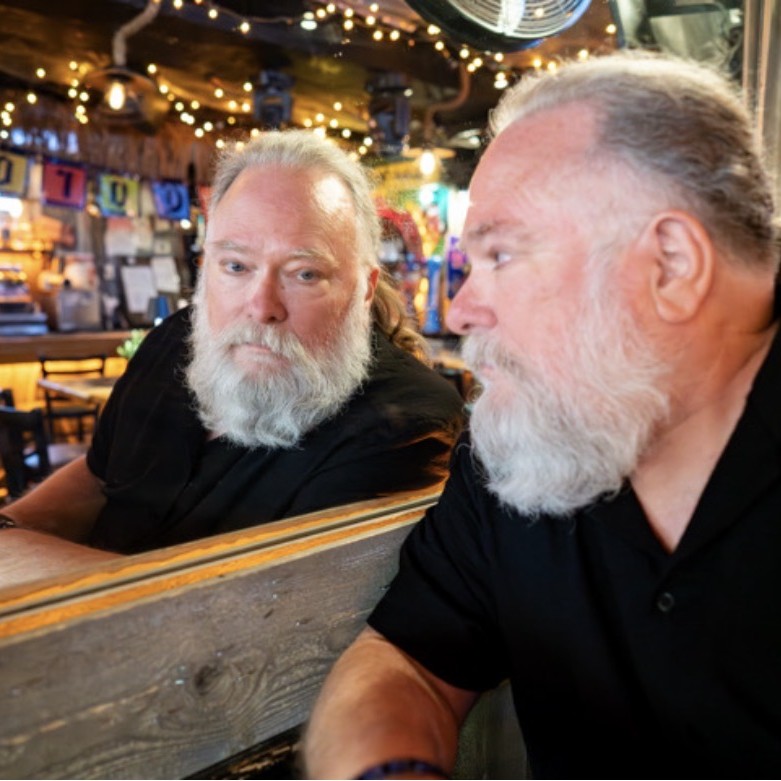
Poet R.G. Evans reflects in the mirror of a pub
The multi-talented R.G. Evans’ poems appear in Mother Monster, Father Fiend: An Anthology of the Monsters Who Raised Us.

Q: Your four poems in Mother Monster, Father Fiend—“Retort,” “Correction,” “Belief,” and “MATCH FLARE, 3 AM”—deal with difficult and complicated family relationships. What made you want to explore these particular ideas through poetry?
A: My daily morning practice is to read a few published poems, paying what William Stafford called “a certain kind of attention.” Most days, inspiration arises organically from the reading, so when it comes time for me to write, what I write about on any given day is a surprise to me. “Retort,” for instance, originated from my encountering the name of the furnace used for cremation. “Belief,” I’m pretty sure, arose from reading a poem about folk beliefs and superstitions. So what made me want to explore these ideas was really the luck of the draw depending on what I may have been reading that day.

Continue reading “R.G. Evans on family, trauma, and poetry in Mother Monster, Father Fiend” →